HR job postings are back to their 2020 level after a 66% fall
Indeed Hiring Lab's index of US HR job postings (February 2020 = 100) peaked at 243 in February 2022, fell to 83 by May 2025 and stood at 99 in the week of Oct 17, 2026. All jobs went from 160 to 106 to 104 over the same weeks. On company career sites today, HR and recruiting are 0.8% of US openings, and recruiting jobs are 30% of those.
What we found
- HR boomed harder than the market: at the Feb 2022 peak HR postings stood at 2.4x their February 2020 level, all jobs at 1.6x.
- Then HR fell further: −66% from peak to low, against −34% for all jobs over the same weeks. That is the 4th steepest fall of the 47 occupations in the index, each from its own peak.
- Since the May 2025 low HR postings are up 20%, all jobs −2%. Over the last year HR is +17% and all jobs +3%. New HR postings, the freshest signal, are +4% on a year ago.
- So the decline was real, and it was the unwinding of a boom: HR postings now sit at 99, just under their February 2020 level, close to all jobs at 104.
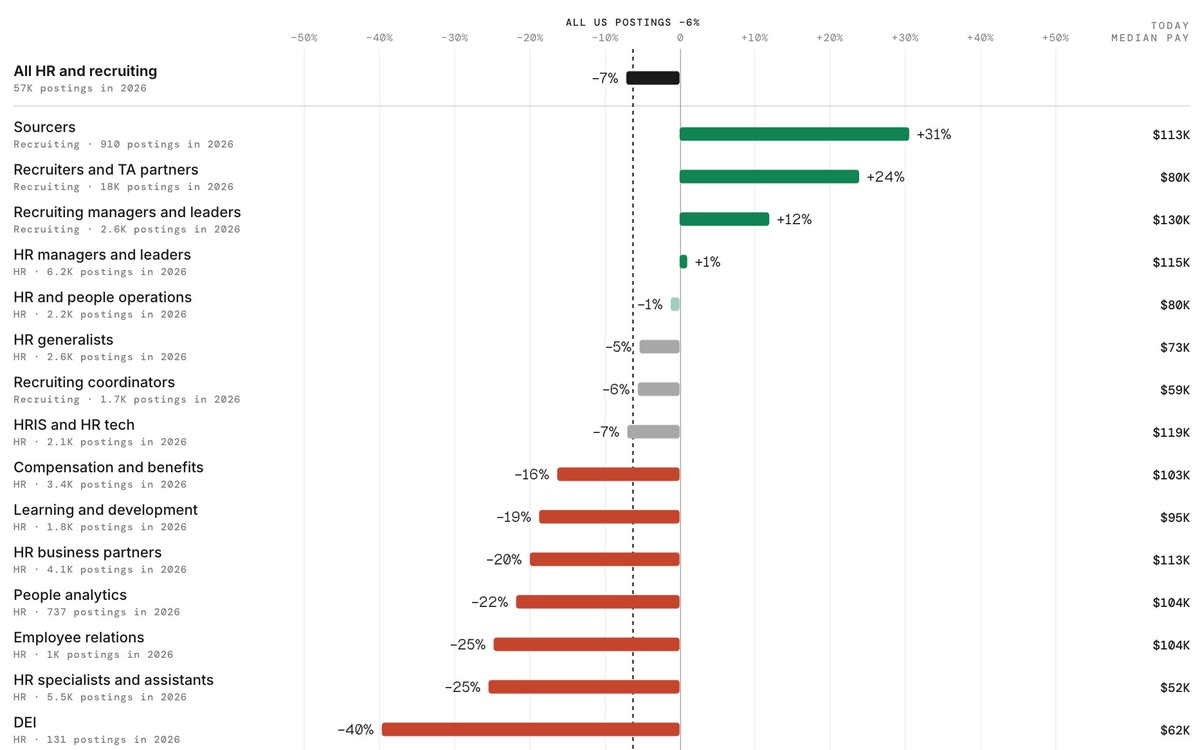
- On LinkedIn and major job boards, HR and recruiting took a bigger share of US postings in Mar to Jul 2026 than a year before: LinkedIn 2.1% to 2.2%, other major boards 1.8% to 2.2%. On LinkedIn, HR and recruiting postings, not counting payroll, held about flat (−0.9%) while all postings fell 6%. Recruiting grew as a part of HR; see which HR jobs are growing.
- Today HR and recruiting are 0.8% of the 2.90M US openings on company career sites (22K jobs, the 18th largest of 20 job functions), and 30% of them are recruiting jobs.
How we made it
Long run: Indeed Hiring Lab's job postings index for the US, seasonally adjusted, one value a week from February 2020 to the week of Oct 17, 2026. Each line is that occupation's postings against its own level on February 1, 2020 (= 100), so lines show change, not size. HR is the index's human resources category.
Peak and low: HR's highest week after mid 2020 (Feb 26, 2022) and its lowest week after that (May 24, 2025). The fall ranking compares each of the 47 occupations from its own peak to its own later low.
Company career sites: every US job open on Nov 5, 2026 on employers' own career sites, one job counted once across copies, staffing agencies and job boards left out. HR and recruiting = the People and HR job family plus any recruiting title (recruiter, talent acquisition, sourcer, recruiting coordinator); recruiting of patients, study participants, students and the military does not count. Career sites carry many store, warehouse and care jobs, so office work like HR is a smaller share there than on job boards.
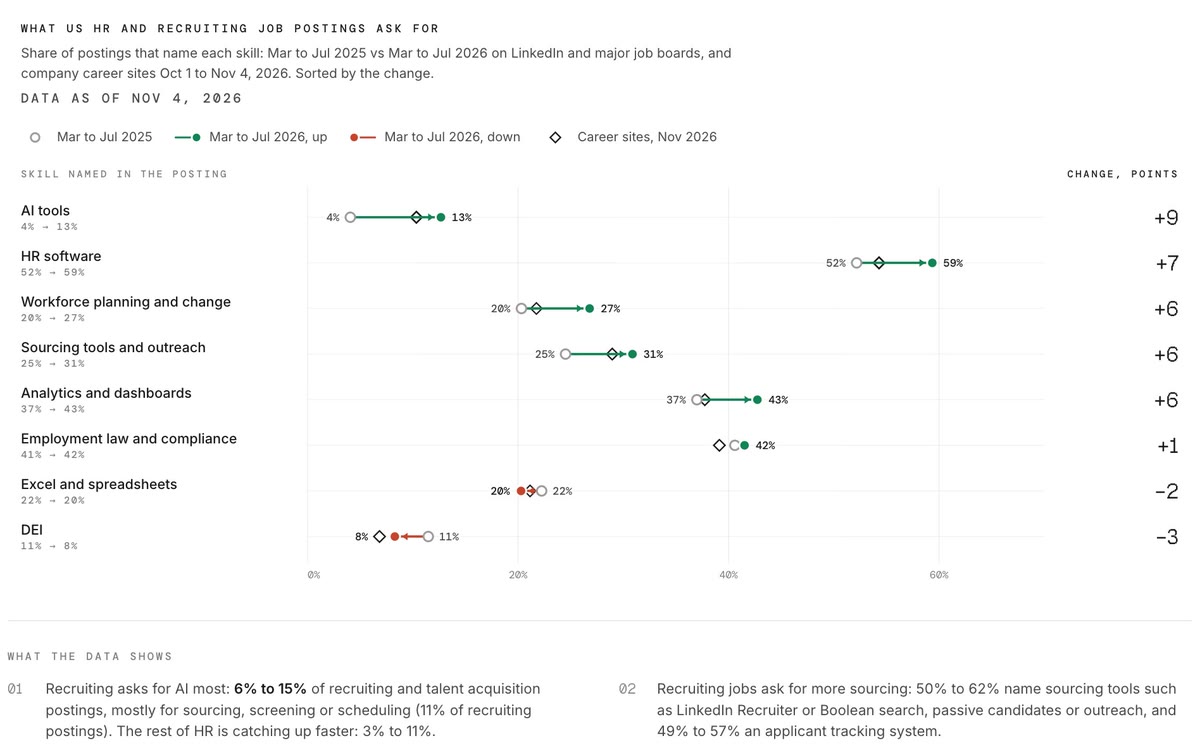
LinkedIn and major job boards: US postings in Mar to Jul of 2025 and 2026, the same months a year apart so the seasons cancel. One posting = company + job title + city within a month and board; staffing agencies and AI training gig listings left out. Same HR rule as above (payroll titles outside the HR family are not counted). The boards held fewer postings in some months than others, so we compare shares within each board, not counts.
These are postings, not hires or jobs filled: they show demand moving, not how many people work in HR.
Run your own study
This research uses the same live job postings you can search through Treg: open roles read daily from employers' own career sites.
Related research